Table of Contents

A practical guide for homeowners who want a cleaner bathroom — not just a prettier one.
There’s a moment in almost every bathroom renovation when someone points at a frameless glass shower door sliding silently along an overhead track and says: I want that.
It looks effortless. It looks expensive. And for a long time, it was.
What’s changed in the last few years is the price — and more importantly, the availability of honest information about what you’re actually buying, what to measure before you order, and what separates a barn door shower system that works beautifully for a decade from one that wobbles and squeaks by year three.
This guide covers all of it.
What Is a Barn Door Shower — and Why Does the Format Matter?
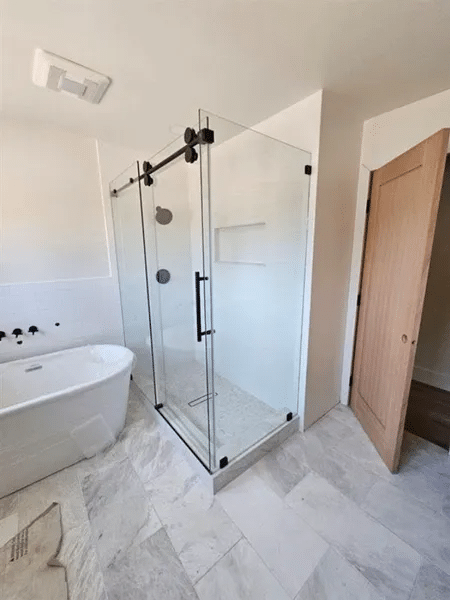
The term “barn door shower” refers to a specific suspension geometry. The glass panel hangs from hardware mounted above the door opening, slides along an overhead track, and all of the panel’s weight is carried by the top hardware. There is no bottom track running across the shower floor.
That last detail matters more than most people realize before they’ve lived with a conventional sliding shower door for a few years.
Standard sliding shower doors — the kind installed in most bathrooms built before 2015 — run the bottom edge of the glass through a floor-mounted channel. That channel sits at floor level in a wet environment and collects everything: water, soap residue, mineral deposits, and eventually mold. Cleaning it requires a narrow brush and a level of consistent attention that most people’s cleaning routines don’t realistically include. Over time, the sealant between the track and the shower floor degrades, and the channel becomes a water infiltration point.
A barn door format eliminates this entirely. The panel glides across a small clearance above the shower floor without touching it. The maintenance obligation that a bottom track creates simply doesn’t exist.
The second advantage is entry clearance. A conventional two-panel bypass door always has one panel partially covering the opening. You enter through whatever width remains. A barn door slides completely to one side — the full opening width is accessible. On a 60-inch shower, that’s the difference between squeezing through a 28-inch gap and walking through a 56-inch opening.
The Renovation Scenario This Format Actually Solves
Before diving into specifications, it’s worth being direct about the use case.
The barn door shower format performs best in these situations: a master bathroom with a walk-in shower between 50 and 65 inches wide, a current door that’s a framed bypass or pivot style showing hardware wear, and a renovation goal of a cleaner, more open aesthetic with less daily cleaning.
It’s not the right fit for every bathroom. If your opening is wider than 65 inches, a double-panel sliding system handles the span better. If you need a swing door for accessibility or layout reasons, a hinged frameless door is the appropriate specification. And if your walls are more than 3/4 inch out of plumb — something worth checking before you order anything — you’ll need to address that first or choose a format with more built-in adjustment range.
For the 50-to-65-inch opening with reasonably plumb walls, the barn door format is genuinely the best combination of aesthetics, maintenance, and long-term performance available at this price range.
The Part Most Buyers Get Wrong: Measuring
Measuring a shower opening for a barn door system is straightforward, but there are two mistakes made consistently enough to be worth addressing directly.
Mistake 1: Measuring before tile is finished. Tile adds 3/8 to 1/2 inch per tiled wall. If you measure the rough opening and order based on that number, you may receive a door that doesn’t fit the finished opening. Always measure after tile work is complete — at three heights (6 inches from the floor, mid-height, and 6 inches below the intended top of the door) — and use the smallest of those three measurements.
Mistake 2: Selecting a size range at the edge of its adjustment span. Barn door systems come in width ranges — for example, a range covering 56 to 60 inches. If your opening measures 59.5 inches at its narrowest point, selecting the 56-to-60-inch range leaves almost no adjustment room. You want your measurement to fall near the center of the range, not at its edge. If you’re between ranges, size down, not up.
Height selection is simpler: measure from the top surface of the threshold or shower floor to your desired door top. Standard options are 76, 80, and 84 inches. For bathrooms with 8-foot ceilings, 80 inches typically provides the best visual proportion. The 84-inch option is a statement specification for bathrooms with ceiling tile extending to 9 feet or higher.
What the Hardware Actually Does — and Why Roller Size Matters
The roller assembly is the component that most buyers don’t think about until something goes wrong with it.
Most retail barn door shower systems use small-diameter rollers — typically in the 25-to-35mm range — made from nylon or plastic, with a basic bearing system. These work fine when new. Under daily use over three to five years, the small contact area concentrates wear on the bearing surfaces. The result is the wobble, noise, and increasing resistance that homeowners describe as needing adjustment — which usually means the roller system is worn, not misadjusted.
What to look for instead: large-format stainless steel rollers with precision sealed bearings and a load rating matched to the glass specification. Larger diameter means more contact surface area and lower wear concentration per use cycle. Stainless steel handles daily shower humidity without corroding. Sealed bearings maintain smooth operation without requiring lubrication or periodic adjustment.
The track material matters equally. A stainless steel roller running on an aluminium track creates the conditions for galvanic wear — two dissimilar metals in a wet environment, accelerating oxidation at the contact point. Matched materials — stainless roller on stainless track — eliminate this.
This is the hardware specification that separates a shower door that still feels solid after 1,400 daily uses (two people, twice a day, for a year) from one that feels worn.
Glass Thickness: Why 3/8 Inch Is Not Optional in This Format
The barn door suspension geometry places specific structural demands on the glass panel that conventional sliding formats don’t.
In a two-panel bypass door, each panel is typically 28 to 32 inches wide and has a bottom track providing lateral stability along the full panel length. In a barn door format, a single panel spans the full opening width — up to 65 inches — stabilized only by the top roller system and a small bottom wall guide. There is no bottom track supporting the panel against lateral deflection.
A larger unsupported span in a wet environment, subjected to daily lateral loading from use, requires stiffer glass to maintain the same deflection characteristics. The physics are not complicated: a 65-inch panel in 1/4-inch (6mm) glass flexes noticeably under lateral load. The same panel in 3/8-inch (10mm) glass deflects approximately 65% less.
The practical difference is tactile and immediate. 3/8-inch glass feels architectural — solid, stable, with no perceptible flex when you push the door. 1/4-inch glass in a barn door format feels like it’s moving when it should be still.
SGCC certification (the Safety Glazing Certification Council standard) is the U.S. benchmark for tempered safety glass — confirming that the glass has been manufactured and tested to break into small blunt pieces rather than sharp shards. It’s the specification to verify when evaluating any shower glass purchase, regardless of format.
The Coating Question: EnduroShield and What It Actually Changes
The barn door format creates a specific visual dynamic that makes glass coating more consequential than on conventional enclosures.
Because the panel is a single continuous piece of glass with no frame breaking up the surface, the entire visible area is one uninterrupted sheet. Water spots and soap residue that might be partially masked by frame lines on a framed door are fully visible across the entire surface of a frameless panel. On uncoated glass, the visual clarity that makes a frameless barn door shower distinctive on installation day starts degrading within weeks.
A hydrophobic nano-coating — the most tested and widely used of which is EnduroShield — changes this dynamic by altering the surface energy of the glass. Water beads and rolls off rather than spreading and drying. Soap residue rinses away with the water rather than bonding to the glass surface.
The maintenance routine on EnduroShield-coated glass is a post-shower squeegee pass — 20 seconds. The maintenance routine on uncoated frameless glass, if you want to maintain the same visual clarity, is weekly cleaning with a glass-specific cleaner and a fair amount of effort.
The coating doesn’t make the glass self-cleaning — it makes the glass cleanable with trivially low effort. For the barn door format specifically, where the entire visual proposition is a single clean pane of glass, this is a meaningful distinction.
Source: EnduroShield product certification data, TÜV Rheinland. Testing parameters: soil adhesion reduction on treated vs. untreated tempered glass under standardized shower simulation protocol.
Finish Selection: Matching to Your Bathroom
Four finishes cover the majority of bathroom hardware directions. A few practical notes on each:
Brushed Nickel is the most versatile and most commonly selected finish for renovation projects. The matte, slightly textured surface pairs with warm white tile, natural stone, and wood accents. It’s forgiving on water spots and fingerprints — the hardware stays presentable between weekly wipe-downs without daily attention.
Matte Black creates strong visual contrast against light tile and transforms the roller hardware from a functional element into a deliberate design feature. It’s the fastest-growing finish selection in new construction and renovation, reflecting a broader shift toward matte black fixtures. Highly forgiving on fingerprints. The contemporary choice for bathrooms where the hardware is meant to be noticed.
Chrome is the classic choice for bathrooms with cool white or gray tile, existing chrome faucets, and a high-contrast contemporary aesthetic. The mirror-polished surface requires more consistent wiping to maintain its finish under daily use — but the visual payoff on large-format roller hardware, which is visually prominent in a barn door system, is distinctive.
Brushed Gold / Satin Brass serves warm-toned bathrooms with earthen tile palettes, warm wood vanities, and a traditional or transitional design scheme. It’s the least common finish selection overall, but the right choice for the specific aesthetic it serves — where nothing else delivers the same result.
Practical guidance: your shower door hardware finish should match your existing bathroom fixtures or create an intentional contrast. What to avoid is an unintentional mix — brushed nickel shower hardware with chrome faucets, where neither finish is dominant and the combination reads as unplanned rather than designed.
The Installation Reality Check
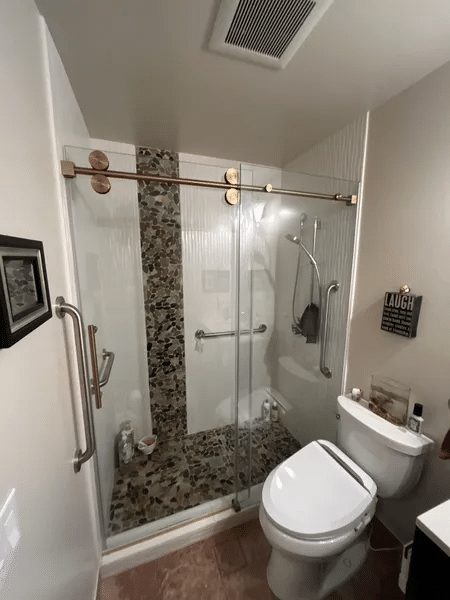
A barn door shower system is a DIY-feasible installation with the right preparation. A few points that determine how the installation goes:
The two-person requirement is real, not a liability disclaimer. A 3/8-inch tempered glass panel spanning 60-plus inches is heavy and completely unforgiving of drops. One person lifts and stabilizes the panel; the second guides the rollers into the track. Attempting a one-person installation on a panel this size risks the glass and the hardware.
The diamond-tip tile drill bit is also not optional. Standard masonry bits crack tile from the edge outward. Diamond-tip bits cut through tile glaze cleanly at medium speed. The additional cost of the correct bit — typically $15 to $25 — eliminates the most common DIY installation damage point.
Wall plumb is worth verifying before you order, not after the door arrives. Hold a 4-foot level vertically against each wall where hardware will mount. Up to 1/8 inch of variance over the door height is within standard tolerance. More than 1/4 inch requires shimming the hardware. More than 3/4 inch is a wall issue that should be addressed before any door is installed.
Neutral-cure silicone sealant at all wall contact points, allowed 24 hours to cure before first use. Standard across all frameless shower door installations — and the step most commonly skipped by people who want to use the shower immediately.
What You’re Actually Buying
A barn door shower system is a bathroom upgrade with a long functional lifespan — if the glass specification, roller hardware, and coating are matched to the format’s structural and maintenance requirements.
The barn door geometry delivers full-width entry clearance, no bottom track, and the cleanest frameless aesthetic available in a residential shower. The 3/8-inch tempered glass provides the structural stiffness the format requires. Large-diameter stainless rollers handle the load rating at daily-use frequency. A factory-applied hydrophobic coating makes the frameless aesthetic maintainable without weekly effort.
Four size ranges cover 50-to-65-inch openings. Three height options reach 84 inches. Four finishes match any bathroom hardware direction. Free nationwide shipping.
If your opening is between 50 and 65 inches and your walls are reasonably plumb, this is the most complete answer to the frameless shower question available at this price point.